I'm an arts management worker/ artist/ designer. I work at Accessible Arts in administration and bookkeeping, but also work on various freelance activities from photography to graphic design. I'm Associate Partner at the ARI, the Big Fag Press, board member of Runway Australian Experimental Art and occasionally work at Bailey and Yang Consultants. My creative work has often been driven by social issues and commentary. This blog started as a way of documenting research for my honours year at uni, which I have continued, in order to gather inspiration for future artistic practice.
I've been AWOL from my blog as of late, and here's why:
In June I applied and received a position at Accessible Arts, an organisation who helps people with disability be fully included in arts and culture in NSW.
Anyway, I'm the Administration Officer and my role is largely database management, day to day bookkeeping with MYOB, and general administration. I am so grateful to be part of such a wonderful group of people, and it feels so rewarding to work towards a cause I believe is so important.
My colleague Jo Agius also welcomes me in her Auslan translation of the newsletter (at 5:24 - 5:40)
We've been learning a bit of Auslan (Australian Sign Language) at work, which I've found very interesting. I can say:
Hi, How are you? Welcome. My name is Louise. I'm 26. I live with my partner, Nathan, I like cats. I have one cat called Poppy. I am the administration person at Accessible Arts.
We've also learnt a host of other useful phases for use around work - things like, Are you busy? Can I help you? What time is the meeting? I forgot. I'm working on MYOB. This week, I'm learning the volunteer procedure. I am working on the database instructions. See you tomorrow. Have a good night/ weekend.
Our upcoming Arts Activated conference means we're also learning to give directions, like "turn left, go up the stairs/lift to the registration desk on level 2 in room 5."
As someone who speaks English, Polish and teaches French, I've found Auslan very interesting from a linguistic point of view. And some of my understanding of language sentence structures and tenses has actually been useful. I'm thinking about maybe taking an Auslan course, but I'm not sure if I have time.
The audio from Supported Studio Networks: Possibility and Potential has just been released. If you want to read a previous blog post about the project, see this previous post of mine.
Artist John Demos and I are panellists at the beginning of this one, Building Culture, but you can find the rest of the audios on the Accessible Arts site.
Josie Cavallaro of Accessible Arts came to visit John during his residency, and asked me to be a panellist on a forum she was organising at the MCA on 7 November about Supported Studio Networks.
Me, John Demos and Kevin Meagher at the MCA
John and I were to be panellists on the section called 'Building Culture', and we had to talk about various aspects of the project we'd just done.
So I sat down with John and chatted about the project, what he'd gotten out of it, what things worked well, what challenges we had, etc. I ended up with a good set of notes both of us could use for the panel. I also had a few notes about some questions we had faced during the course of the project about disclosure and journalist responsibility.
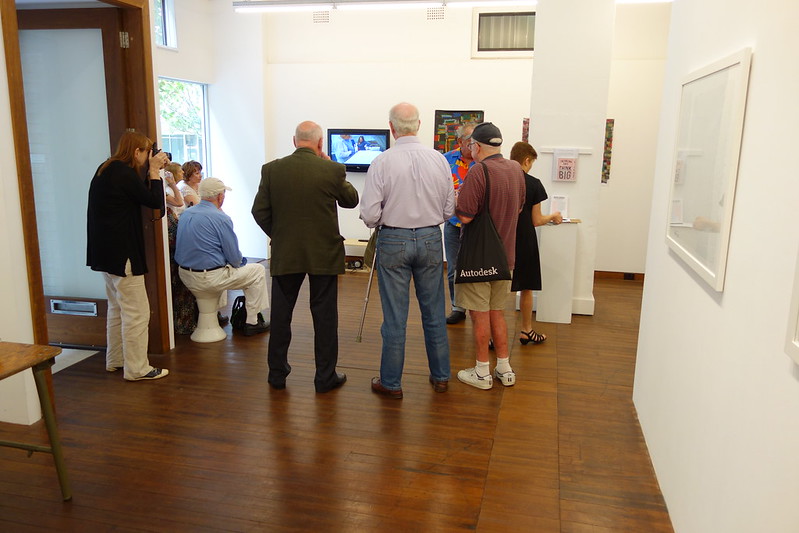
The forum Supported Studio Networks: Possibility and Potential took place at the MCA. Glenn Barkley was the opening speaker, and other panellists included Damien Minton and Evan Hughes. Many of the delegates were key figures in the Sydney art community.
I was a little nervous, but several people said I was very engaging, so I suppose it went well. I was very proud of John who I'm sure was just as nervous as I was. His speech was great too.
An article by Gina Fairley emerged a few weeks later on arts hub called 'Is Outsider Art finally over?' which quoted several of the things I'd said. I wish they had quotes John too though.
The residency went very well. John got a lot of prints and experiments out of his budgeted printing days, and was thrilled to see the press in motion printing his work.
Kristina Tito and I applied on his behalf to NAVA for a small grant to pay for some promotional material and other odds and ends to fund John's exhibition at The Cross Art Projects.
I designed a small catalogue, which was printed on our friends in print The Rizzeria.
John Demos Catalogues, Photo Mine
You can "read" the catalogue here:
The exhibition gathered John some publicity, like on Two Thousand which I was pleased about. I spoke about the residency and the exhibition on Eastside Radio in an interview, and an article about the project, Finding a place in the artworld, by Lucas Ihlein was published in Realtime Arts Magazine.
Antitoxicus Toxic by John Demos, 2013. Photo Louise Anderson
Blue Light and Black Window by John Demos, 2013. Photo Louise Anderson
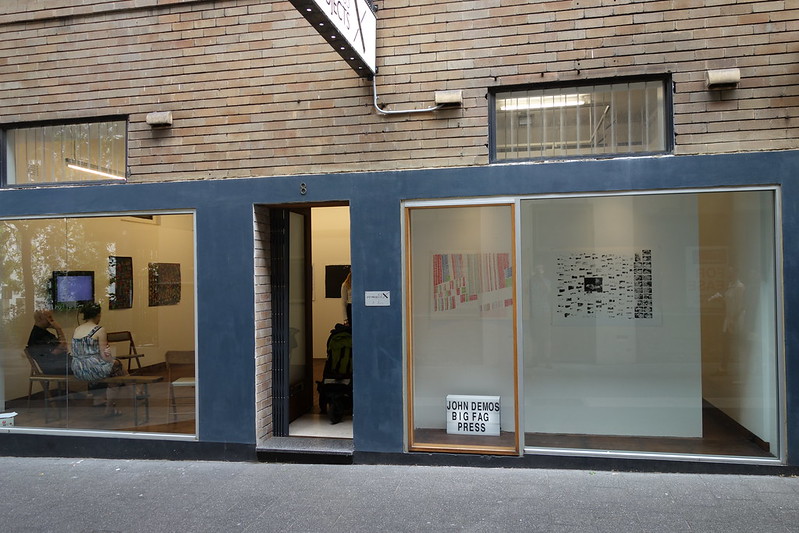
Exhibition at The Cross Art Projects, Kings Cross, 2013. Photo Lucas Ihlein
Exhibition at The Cross Art Projects, Kings Cross, 2013. Photo Lucas Ihlein
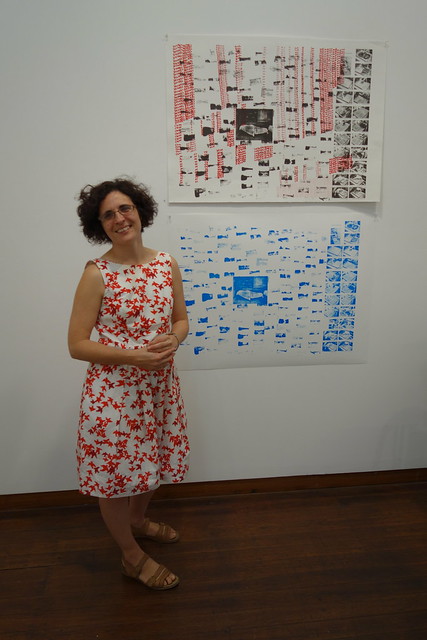
Josie Cavallaro, Accessible Arts. Photo Louise Anderson
Josie Cavallaro from Accessible Arts made a small speech about the project to open the exhibition. Unbeknown to anyone, John came along with his own little speech written out on a tiny piece of paper, to thank everyone for the opportunity. It was a very proud moment for me.
From the left: John Demos, Artist; Tim Barbarino, Big Fag Intern; Lucas Ihlein, Big Fag Partner; Kris Tito, John's liaison at Project Insideout; Louise Anderson (me), and Diego Bonetto, Big Fag Partner.
Josh Charles' beautiful documentary was screened in its entirety at the exhibition as well:
Yesterday courtesy of the Big Fag (thanks guys!), I attended a course on disability training at Accessible Arts run by Amanda Tink.
This was instigated by my project with John Demos, who's been doing a residency with our Press, funded by Arts NSW and administered by Accessible Arts.
There were quite a few things I learnt that I didn't know before. I generally treat everyone around me with respect, but when it comes a person with a disability, it's important to understand life from their perspective and make sure you know what phrases to use and how to approach them.
The section on stereotypes was one I was already very familiar with, but the section on communication was an important one for me. The difference, for example, between saying to a person who uses a wheelchair "do you need some help?" and "would you like some help?" is a good example because the idea of need perhaps takes away a little of their feelings of independence. That said, a person with a disability is not necessarily always in need of help - and they probably get asked that question about 10 times a day.
There's also many disabilities that are invisible. In fact, 1 in 5 Australians identify with having a disability, but the most prominent kinds of disabilities are psychological or health related. These people may find it difficult in work places as to whether or not to disclose their disability. Disclosure may mean they for example, would not prevail in a job interview. However should they not disclose, their disability may cause them difficulty at work.
Language was also a key factor of the training session. Personally, I would never use words like spastic or retard, but I wasn't aware that perhaps a word like "handicapped" might cause offence. The best way to refer to people with impairments is to first regard them as a person, and to not assume anything about their life. So for example, you should say a "person with cerebral palsy" not "he suffers from cerebral palsy". You should not say "the deaf man", you should say "person who is deaf/ hearing impaired". And generally, it's better to find out a person's name! Also never talk about them as if they are not present, obviously. There's also things like being honest if you haven't understood what a person has said, and knowing the difference between simple language and moderate speed as opposed to talking to someone as if they were a child.
One thing that came up was how some people who are deaf sometimes don't consider themselves to have an impairment at all. Rather, that their ability to use sign language simply places them in a separate linguistic culture, one which has been extensively developed. I didn't know that before.
50 years ago being left handed was considered something of a disability. 20 years ago being gay meant you had a psychiatric condition. It's the society and world that shifts. It was interesting to look at how society has treated the issue of disability over time, beginning with a religious perspective that a person with an impairment must be so because he had sinned, or his family had sinned. Then from a medical perspective we would do the best for a person we could medically, and then they would just have to do the best they could to try and integrate within their family and get by.
The current model stemmed from the UK in the 70's where we think of people who have an impairment as not them being disabled, but rather than society itself is disabling them because of all the barriers they face, taking a wheelchair up stairs, or trying to find a cinema session that has audio captions.
Not many organisations have Disability Action Plans - only about 40% of arts organisations in Australia. It's important to understand that it's not a matter of building a ramp and hanging some audio tour headphones on the walls, it's about creating an environment that is entirely welcoming and not hostile through a range of means, both physical and emotional, and then, making the community of people with disabilities aware of those changes.
Anyway, I learnt a lot at the training session and I'm sure it will help me in my many current endeavours!