About Me

My photo
Sydney, NSW, Australia
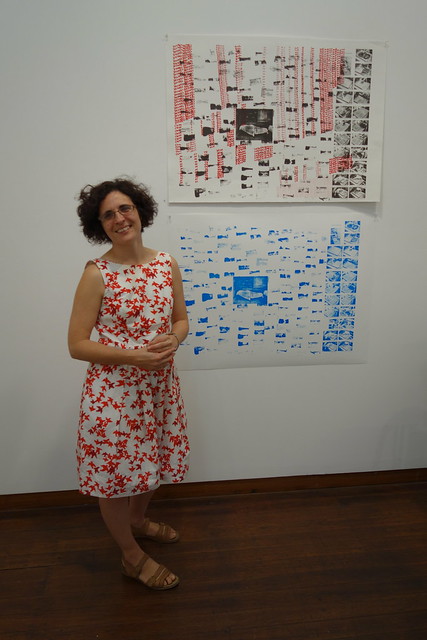
I'm an arts management worker/ artist/ designer. I work at Accessible Arts in administration and bookkeeping, but also work on various freelance activities from photography to graphic design. I'm Associate Partner at the ARI, the Big Fag Press, board member of Runway Australian Experimental Art and occasionally work at Bailey and Yang Consultants. My creative work has often been driven by social issues and commentary. This blog started as a way of documenting research for my honours year at uni, which I have continued, in order to gather inspiration for future artistic practice.

Thursday, January 2, 2014

The Yeomans Project - Art Gallery of NSW

In 2011, I started working on printing a series of works by Lucas Ihlein and Ian Milliss for the Yeomans Project on the Big Fag Press which was to be exhibited at ACCA in Melbourne. You can see I wrote a post about it in my blog here. The prints went on to win the 2012 Fremantle Arts Centre Print Award.

Here is Lucas holding up one of the prints:


In the lead up to another Yeomans exhibition, this time at the Art Gallery of NSW, Lucas Ihlein and Ian Milliss asked me to assist them in some of the legwork for the show, mainly making up some posters, and designing a newspaper based on their research blog.

The Yeomans Project recognises the work of PA Yeomans, an Australian inventor who came up with what's known as the Keyline concepts in agriculture and farming. The AGNSW exhibition is interestingly retrospective, as a similar proposal for an exhibition was rejected in the 70s when the trustees felt that such work was not art. Just goes to show how the meaning of art has changed in the last 40 years!

The posters I designed were based on websites of other artists or artist groups who use agriculture, farming or food as the basis of their art practice: (f)route, Artist as Family, Milkwood Permaculture and Diego Bonetto (who is also a partner of the Big Fag Press).

An interesting off-topic note: When I did my short course on social media business marketing at Media School, (who have no particular association with art or agriculture), Milkwood Permaculture were their prime example of awesome social media marketing. Small world, huh?

Anyway, for the posters, I had to request high resolution images and names of fonts, and loosely put together information about each artists' practice in one poster for the exhibition. Here are some of my proof prints stuck to my hallway wall! (yes they look better in the art gallery).


And here are the posters in the gallery (and Diego next to his one). I keep meaning to get back to the AGNSW and take some better photos of the whole exhibition but I haven't had time! If you wanted to see some of Lucas' photos of the launch, they are here.


The University of Wollongong (where Lucas teaches Media & Arts) funded the production of a newspaper for the exhibition which was based on the Yeomans Project blog.

It was a great experience getting it printed at MPD in Alexandria. At the Big Fag we print one hand fed sheet at a time, one colour at a time, about 100 imprints a day, not to mention an hour of cleaning up. I've explained our process in more detail in this post from ages ago. For this newspaper, MPD were using their web press machine. Now, the big fag is big, but, this is a BIG machine:


These are the rolls of paper they use to feed through the machine:


And here are the first proofs I had to look at to see if the colours were all right. (This took a bit of time).


Then see all these knobs here? Apparently they change the balance of the ink somehow. So for example, when I said a page was looking too yellow, they could fix it for the next proofing.


Here is my contact at MPD, Eleanor holding up one of the plates they use in the machine. They don't look too much different to our Big Fag plates! And on the right is the big roll of paper being fed into the machine.


So, the Big Fag does about 100 imprints of one giant page a day, and that's just one colour... this web press machine does 15,000 copies of a full colour newspaper in 1 hour! Here are some videos of the newspaper being printed:


Amazing! I would love to know more about how the web press machine works, I think it's fascinating.

So, all this was great fun but a harrowing few weeks designing the posters and newspaper during the time I was working at Sculpture by the Sea. I'm really proud of the way it all looks though!

 Art Gallery of NSW advertising for the Yeomans Project

The AGNSW exhibition is on in the Contemporary Project Space until 27 January 2014. The newspapers are free at the exhibition, so please pick one up!


*All photos and videos are mine, unless captioned otherwise.

Monday, December 30, 2013

Supported Studio Networks - new questions in art?

This post is an addendum to two previous blog posts about John Demos' residency at the Big Fag Press, and his exhibition at The Cross Art Projects that followed.

Josie Cavallaro of Accessible Arts came to visit John during his residency, and asked me to be a panellist on a forum she was organising at the MCA on 7 November about Supported Studio Networks.

Me, John Demos and Kevin Meagher at the MCA
John and I were to be panellists on the section called 'Building Culture', and we had to talk about various aspects of the project we'd just done.

So I sat down with John and chatted about the project, what he'd gotten out of it, what things worked well, what challenges we had, etc. I ended up with a good set of notes both of us could use for the panel. I also had a few notes about some questions we had faced during the course of the project about disclosure and journalist responsibility.

The forum Supported Studio Networks: Possibility and Potential took place at the MCA. Glenn Barkley was the opening speaker, and other panellists included Damien Minton and Evan Hughes. Many of the delegates were key figures in the Sydney art community.

I was a little nervous, but several people said I was very engaging, so I suppose it went well. I was very proud of John who I'm sure was just as nervous as I was. His speech was great too.

An article by Gina Fairley emerged a few weeks later on arts hub called 'Is Outsider Art finally over?' which quoted several of the things I'd said. I wish they had quotes John too though.

I wrote a small response to the forum for the Runway news section, 'Out with Outsider Art'.

The Accessible Arts forum podcast and transcript will be available soon in 2014 online.

Program for the Section 'Building Culture'

Wednesday, December 4, 2013

Runway Australian Experimental Art - goes LIVE

Runway is a niche artist run magazine of which I joined the management in February this year. We've been working all year on relaunching as a free, online journal rebranded as Runway Australian Experimental Art, and expanding our audience to an international readership in order to promote the work of Australian contemporary artists both at home and overseas.

I was elected secretary of the management board, was part of the website design subcommittee and have been running the social media platforms.

The website <http://runway.org.au/> goes live as I'm typing this in 27 minutes - I'm so excited!

Here is my board member profile page.

And here is a blog post I wrote for the news section regarding another project I've been working on.

And here is the launch poster if you'd like to come along. The Sydney launch is at Archive Space in Newtown at 6pm tomorrow.


Monday, December 2, 2013

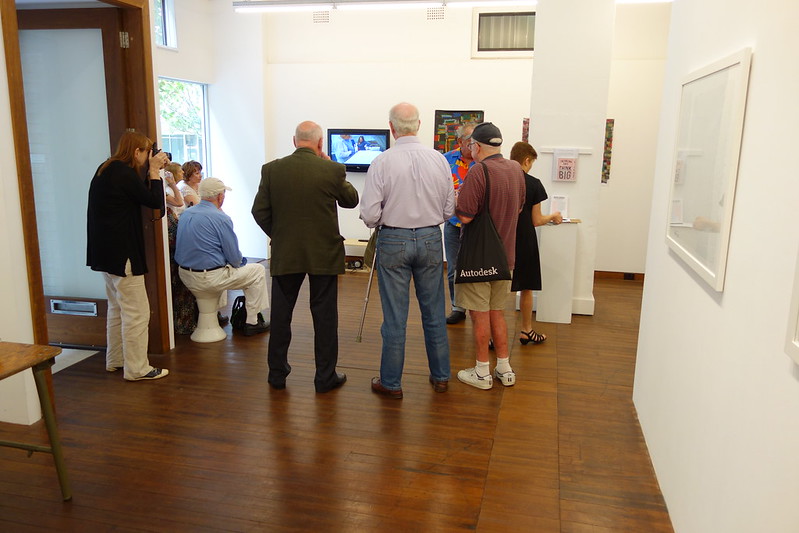
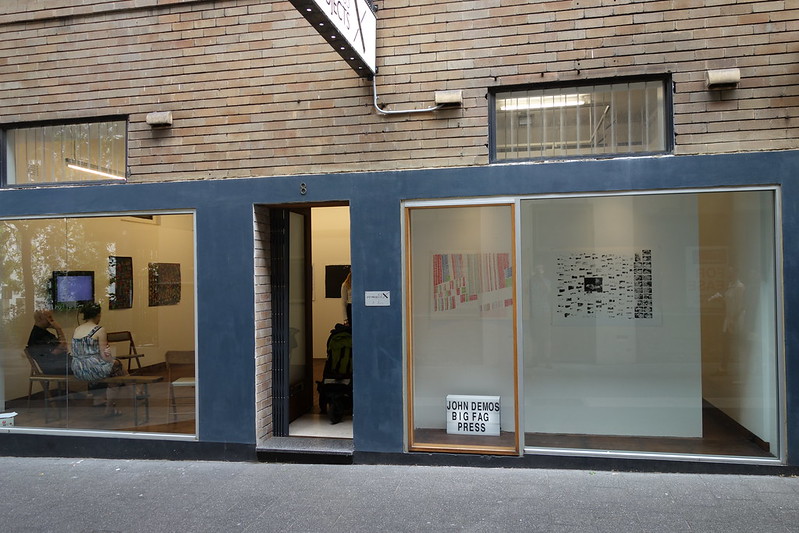
John Demos at Big Fag (at The Cross Art Projects)

In this post I spoke about our Big Fag Press Residency with John Demos, a project organised through Accessible Arts.

The residency went very well. John got a lot of prints and experiments out of his budgeted printing days, and was thrilled to see the press in motion printing his work.

Kristina Tito and I applied on his behalf to NAVA for a small grant to pay for some promotional material and other odds and ends to fund John's exhibition at The Cross Art Projects.

I designed a small catalogue, which was printed on our friends in print The Rizzeria.

John Demos Catalogues, Photo Mine
You can "read" the catalogue here:


The exhibition gathered John some publicity, like on Two Thousand which I was pleased about. I spoke about the residency and the exhibition on Eastside Radio in an interview, and an article about the project, Finding a place in the artworld, by Lucas Ihlein was published in Realtime Arts Magazine.

Antitoxicus Toxic by John Demos, 2013. Photo Louise Anderson
Blue Light and Black Window by John Demos, 2013. Photo Louise Anderson
Exhibition at The Cross Art Projects, Kings Cross, 2013. Photo Lucas Ihlein
Josie Cavallaro, Accessible Arts. Photo Louise Anderson


Josie Cavallaro from Accessible Arts made a small speech about the project to open the exhibition. Unbeknown to anyone, John came along with his own little speech written out on a tiny piece of paper, to thank everyone for the opportunity. It was a very proud moment for me.

From the left: John Demos, Artist; Tim Barbarino, Big Fag Intern; Lucas Ihlein, Big Fag Partner; Kris Tito, John's liaison at Project Insideout; Louise Anderson (me), and Diego Bonetto, Big Fag Partner.

Josh Charles' beautiful documentary was screened in its entirety at the exhibition as well:


John Demos at the Big FAG Press from Josh Charles on Vimeo.

The project was part of a panel discussion at Accessible Arts on 6 November 2013, but that's a subject for a later post.

Sculpture by the Sea

You may have noticed I've been very quiet on here. The next 4 or 5 posts should definitely explain why!

I was very proud to get a 2 day/week internship at Sculpture by the Sea about 4 months ago, which quickly progressed into a full time paid load unexpectedly. So for the past 2 months or so, I've been Exhibition Assistant to the Exhibition Coordination team for the Bondi 2013 show. Along with my French HSC tutoring, and various other freelance commitments, it's been a very stressful couple of months.

My responsibilities in the office included data entry, organising the office move out to Bondi, liaising with artists, social media scheduling, phone and reception assistance, putting together volunteer and artist information packs, stock ordering, helping to write our e-news, redirecting our mail and helping to finalise details like sponsor logos, dimensions and images for our exhibition catalogue. I also used my Indesign skills to create lanyards and badges for all staff, artists and volunteers.


Sculpture by the Sea, Bondi exhibition catalogue cover
Once we moved out to Bondi, in addition to the above, I was organising and directing volunteers, distributing catering, assisting with general enquiries, directing traffic and parking, driving various visitors in our sponsored car, communicating with all staff and site crew via 2 way radios, conducting visitor surveys, counting crowds, liaising with our publicity team, and occasionally assisting in small urgent situations like injuries. Sydney had a tough day a couple of weeks ago with some very windy weather, and being on the coastline was a tricky situation.

One thing I was particularly responsible for was artist talks on the weekends. I contacted and scheduled the artists and ran the artist talks event, which included distributing posters and information, bringing all the necessary material and moving around feather banners, beanbags, A frames and signs.

Here are some images of artist Simon McGrath explaining his work Virtually Melted, which is a site specific work consisting of a smart phone application that makes the image of an iceberg appear above the water to recognise the effects of global warming. These photos are mine.


I kept meaning to get up super early and take some great sunrise photos, but the role was very tiring and I didn't manage to actually walk through and see all the sculptures until just before the end! Unfortunately with the sun setting in the west as it usually does, sunset photos weren't as spectacular as the ones I've seen of Sculpture by the Sea, Cottesloe, in Perth.

We've just finished the Bondi show, I fell in love with quite a few of the works (my taste generally leans towards the more contemporary ideas or to works which have a political or social concept behind them). 

Carole Purnelle and Nuno Maya, Plastic World
Mikaela Castledine, East of the Mulberry Tree - the Legend of the Ten Red Crows

Carl Billingsley, Red Center
Lucy Humphrey, Horizon
Qian Sihua, Bubble No.5
Phil Price, Snake
Chen Wenling, Rainbow
Mia Hamilton, French Knitting
Robert Hague, detail of Monument
Magarita Sampson, The Great Bondi Sharehouse
Coral Collective, Coral
Alison McDonald, Flow (2011)

Elyssa Sykes-Smith, A Shared Weight
Unfortunately I don't have photos of all my favourites. Here are some from our great photogs at the event:


Simone & Justin Drape, Room Without a View Photo: Clyde Yee

Jack Davis, A Force of Nature Photo: Jarrad Seng
Robert Barnstone, Once Removed Photo: Jarrad Seng
Tunni Kraus, Washed Up Photo: Clyde Yee
You can see some more day to day photos if you follow me on instagram.

Saturday, September 7, 2013

Accessible Arts Disability Training Day


Yesterday courtesy of the Big Fag (thanks guys!), I attended a course on disability training at Accessible Arts run by Amanda Tink.

This was instigated by my project with John Demos, who's been doing a residency with our Press, funded by Arts NSW and administered by Accessible Arts.

There were quite a few things I learnt that I didn't know before. I generally treat everyone around me with respect, but when it comes a person with a disability, it's important to understand life from their perspective and make sure you know what phrases to use and how to approach them.

The section on stereotypes was one I was already very familiar with, but the section on communication was an important one for me. The difference, for example, between saying to a person who uses a wheelchair "do you need some help?" and "would you like some help?" is a good example because the idea of need perhaps takes away a little of their feelings of independence. That said, a person with a disability is not necessarily always in need of help - and they probably get asked that question about 10 times a day.

There's also many disabilities that are invisible. In fact, 1 in 5 Australians identify with having a disability, but the most prominent kinds of disabilities are psychological or health related. These people may find it difficult in work places as to whether or not to disclose their disability. Disclosure may mean they for example, would not prevail in a job interview. However should they not disclose, their disability may cause them difficulty at work.

Amanda played us this amazing video from the UK Disability Rights Commission: (you can find the second part on YouTube)


Language was also a key factor of the training session. Personally, I would never use words like spastic or retard, but I wasn't aware that perhaps a word like "handicapped" might cause offence. The best way to refer to people with impairments is to first regard them as a person, and to not assume anything about their life. So for example, you should say a "person with cerebral palsy" not "he suffers from cerebral palsy". You should not say "the deaf man", you should say "person who is deaf/ hearing impaired". And generally, it's better to find out a person's name! Also never talk about them as if they are not present, obviously. There's also things like being honest if you haven't understood what a person has said, and knowing the difference between simple language and moderate speed as opposed to talking to someone as if they were a child.

One thing that came up was how some people who are deaf sometimes don't consider themselves to have an impairment at all. Rather, that their ability to use sign language simply places them in a separate linguistic culture, one which has been extensively developed. I didn't know that before.

50 years ago being left handed was considered something of a disability. 20 years ago being gay meant you had a psychiatric condition. It's the society and world that shifts. It was interesting to look at how society has treated the issue of disability over time, beginning with a religious perspective that a person with an impairment must be so because he had sinned, or his family had sinned. Then from a medical perspective we would do the best for a person we could medically, and then they would just have to do the best they could to try and integrate within their family and get by.

The current model stemmed from the UK in the 70's where we think of people who have an impairment as not them being disabled, but rather than society itself is disabling them because of all the barriers they face, taking a wheelchair up stairs, or trying to find a cinema session that has audio captions.

Not many organisations have Disability Action Plans - only about 40% of arts organisations in Australia. It's important to understand that it's not a matter of building a ramp and hanging some audio tour headphones on the walls, it's about creating an environment that is entirely welcoming and not hostile through a range of means, both physical and emotional, and then, making the community of people with disabilities aware of those changes.

Anyway, I learnt a lot at the training session and I'm sure it will help me in my many current endeavours!

Wednesday, August 14, 2013

John Demos' Accessible Arts Residency at the Big Fag


John Demos. Photo Louise Anderson

John Demos working at the Big Fag Press, Photo Louise Anderson

John Demos with his original work "Antitoxicus" Photo Louise Anderson

For about 3 months we've had John Demos down at Firstdraft Depot working on some prints on the Big Fag as part of his residency mentorship program thanks to his Amplify Your Art grant. John has been coming in one day a week to create his beautiful works and experience the process of making those works into prints on our offset proofing press.

I've been mostly managing this project solo, and it's been an amazing experience for me. Art is the way John experiences his life, and his works are an exploration of belonging and home, and the words and images that mean those things to him. When he's not practising, John is browsing countless Sydney galleries where the attendants all know him by name. This is a kind of passion I feel is rare in just about any field.

Whilst down at the Press, I introduced John and his liaison Kristina Tito to Jo Holder from The Cross Art Projects gallery. He's been offered the opportunity to exhibit his work at the end of our mentorship there in October/ November. This is such a great opportunity for him to make contacts, show his work and most importantly give a voice to artists like himself who benefit so much from Supported Studio Networks.

We're just in the printing phase now, and the entire project is taking shape. I organised some paper sponsorship from K.W. Doggett, which has been great for John to experiment on. He loves discovering new kinds of paper and mediums to work with, and asks endless questions about ink mixing, how the press works and what kind of things we've printed on before.

We've made up ten metal plates of John's work separated into different colours, and he'll end up with a series of about 4 works, plus a few others where he will experiment with layering different works on top of each other, and then using them as a basis for more hand- rendered work.

Josh Charles has been making a short documentary of the entire project.

Spending any time at all with John has shown me that he has a little story about everything. It's really important to give John a platform from which to tell those stories - through his art, but also his practice, which can potentially, as he says, "influence other people towards art".

Thursday, July 18, 2013

Review of Justin Shoulder & Collaborators: The River Eats

A couple of weeks ago Diego Bonetto printed Justin Shoulder's Poster for the River Eats on our Big Fag Press machine. The poster itself is amazing - one of the most intricate, visually engaging prints we've done.

As a thank you, Justin got Diego and I a couple of seats at the preview show at Performance Space a couple of weeks ago.
Poster for the River Eats, design by Matt Stegh, printed on the Big Fag Press

The River Eats is Justin Shoulder and collaborator's phantasmagorical performance which flabbergasts the audience with its somewhat trippy tale of a creature called Pinky who transforms from a histrionic self-obsessed attention whore into a mesmerising butterfly.

The scintillating performance is an overwhelming sensual experience - hypnotic light movements and dramatic music hold you spellbound while Pinky prances around in exquisite costumes undergoing her (its?) identity metamorphosis.

The audience sits disillusioned in a way that cannot quite be described in words, unsure of whether to laugh or clap, and half feeling like they may have fallen into a psychedelic dream or unknowingly consumed some illegal substance.

The River Eats was a confronting experience. The one word that came to my mind whilst watching was akrasia - the concept of acting against one's better judgement, despite conscious knowledge and prescience of events to come. This is a phenomenon which I think is present in many a mind's decision in the modern world. When this psychological conflict is applied to identity, we have people are caught in a constant battle between who they are, who they think they should be, and who society sees them to be.

Pinky is caught in this battle, and frolics from one spotlight to the next until (s)he is confronted by her equal and opposite identity, exorcises yearning for fame and fiction, and is eventually reborn into the character Oo - a beautiful black and pink butterfly whose force is derived from the river, from nature.

Justin Shoulder has created a plethora of strange creatures like Pinky, often inspired by various cultural traditions, fables, myths, stories and masquerade, and all with the intent to deconstruct how we emotionally relate to our reality.

Pinky specifically was derived from the idea in Taoism that identities have a sort of Yin and Yang, that every energy force has an equal opposite. Shoulder was also inspired by a visit to the Brazilian Amazon, which for him embodied notions of life and death, rebirth and decay.