About Me

My photo
Sydney, NSW, Australia
I'm an arts management worker/ artist/ designer. I work at Accessible Arts in administration and bookkeeping, but also work on various freelance activities from photography to graphic design. I'm Associate Partner at the ARI, the Big Fag Press, board member of Runway Australian Experimental Art and occasionally work at Bailey and Yang Consultants. My creative work has often been driven by social issues and commentary. This blog started as a way of documenting research for my honours year at uni, which I have continued, in order to gather inspiration for future artistic practice.
Showing posts with label Inspiration. Show all posts

Thursday, July 18, 2013

Review of Justin Shoulder & Collaborators: The River Eats

A couple of weeks ago Diego Bonetto printed Justin Shoulder's Poster for the River Eats on our Big Fag Press machine. The poster itself is amazing - one of the most intricate, visually engaging prints we've done.

As a thank you, Justin got Diego and I a couple of seats at the preview show at Performance Space a couple of weeks ago.
Poster for the River Eats, design by Matt Stegh, printed on the Big Fag Press

The River Eats is Justin Shoulder and collaborator's phantasmagorical performance which flabbergasts the audience with its somewhat trippy tale of a creature called Pinky who transforms from a histrionic self-obsessed attention whore into a mesmerising butterfly.

The scintillating performance is an overwhelming sensual experience - hypnotic light movements and dramatic music hold you spellbound while Pinky prances around in exquisite costumes undergoing her (its?) identity metamorphosis.

The audience sits disillusioned in a way that cannot quite be described in words, unsure of whether to laugh or clap, and half feeling like they may have fallen into a psychedelic dream or unknowingly consumed some illegal substance.

The River Eats was a confronting experience. The one word that came to my mind whilst watching was akrasia - the concept of acting against one's better judgement, despite conscious knowledge and prescience of events to come. This is a phenomenon which I think is present in many a mind's decision in the modern world. When this psychological conflict is applied to identity, we have people are caught in a constant battle between who they are, who they think they should be, and who society sees them to be.

Pinky is caught in this battle, and frolics from one spotlight to the next until (s)he is confronted by her equal and opposite identity, exorcises yearning for fame and fiction, and is eventually reborn into the character Oo - a beautiful black and pink butterfly whose force is derived from the river, from nature.

Justin Shoulder has created a plethora of strange creatures like Pinky, often inspired by various cultural traditions, fables, myths, stories and masquerade, and all with the intent to deconstruct how we emotionally relate to our reality.

Pinky specifically was derived from the idea in Taoism that identities have a sort of Yin and Yang, that every energy force has an equal opposite. Shoulder was also inspired by a visit to the Brazilian Amazon, which for him embodied notions of life and death, rebirth and decay.


Sunday, November 25, 2012

Francis Bacon AGNSW

Normally, I'm more a fan of the contemporary art side of things, but I don't pass up the chance to see complete collections of renowned artists' whom I've studied, when they're exhibited in Sydney for a short time.

Conceptually, I liked seeing the progression of Bacon's art to the events happening both in the world (such as the legalisation of homosexual sex), and in his life (such as the death of his lover). His paintings offered a window into his personality and struggles.

Many of his works were portraits of people he had strong relationships with, and some of his source material like photographs found in his studio really struck me.


*2 images: Photographer John Deakin

Often, exhibitions inspire me in strange ways, and I find myself rushing home to start a new project of some kind. In this case, I dug out my old SLR camera and am currently planning on reminding myself how to load/develop/print film photos so that I can justify taking both my DSLR and my SLR with me on my trip to Vietnam early next year. It's been a very long time since I've done any portrait SLR work, and I just realised how much I missed it.

Monday, July 30, 2012

Free Money!


I came across this on facebook - Doug Eaton decided to spend his 65th birthday doing good deeds for others. He wrote out this sign and was giving away $5 notes to passers by.

I like this idea because it has beautiful anti-superficial ideas and a strong focus on getting people to think about their social responsibility. To me it says, you know, if you have the basic financial situation to provide for the things you really need, then you're doing okay, and if you can't afford that huge screen tv, you'll probably still survive. I think when asked for money from the homeless, everyone at least occasionally thinks, "well, I need my money" (I know I do). But as the sign says, if you have the basics, you can always afford a few dollars. ((Says me, who's just purchased a shiny laptop!!))

Of course, I tend not to like giving out money because I want to know what happens to my few dollars, which is why I'm always giving away my lunch instead!

It was suggested on a blog somewhere I read that this guy is probably religious. I find that a little presumptuous. Can atheists not do good deeds?


Thursday, May 24, 2012

Semi- Permanent Sydney 2012

I went to the Semi-Permanent, Sydney 2012 conference a few days ago, which was well worth the money in the ideas and inspiration that it gave me. I always take a lot away from hearing about projects other people are doing.

Here are the talks which stood out most to me:

Kelli Anderson is an American graphic designer who had a number of extremely interesting works to show us including moving images called kinographics, and paper that can play music. Two of her works stood out to me as being relevant to my project. The first was her collaboration with the Yes Men, and their 2008 hoax New York Times newspaper.

 *Image: the Yes Men

This fabulously copied counterfeit newspaper presented a blueprint for a Utopian future, from Maximum Wage Laws and the end of the Iraq war to ads for where to trade in your car for a bicycle. Here are some of the reactions from people on the street:


Unfortunately the hoax NY times website doesn't seem to be working anymore. This fantastic piece of satire and verisimilitude reminds me of the Onion, except the latter is usually about getting a horrified reaction to terrifying fake news such as "New Law Requires Women to Name Baby, Paint Nursery before getting Abortion", while the Yes Men wanted people to wish that their Utopian newspaper was real.

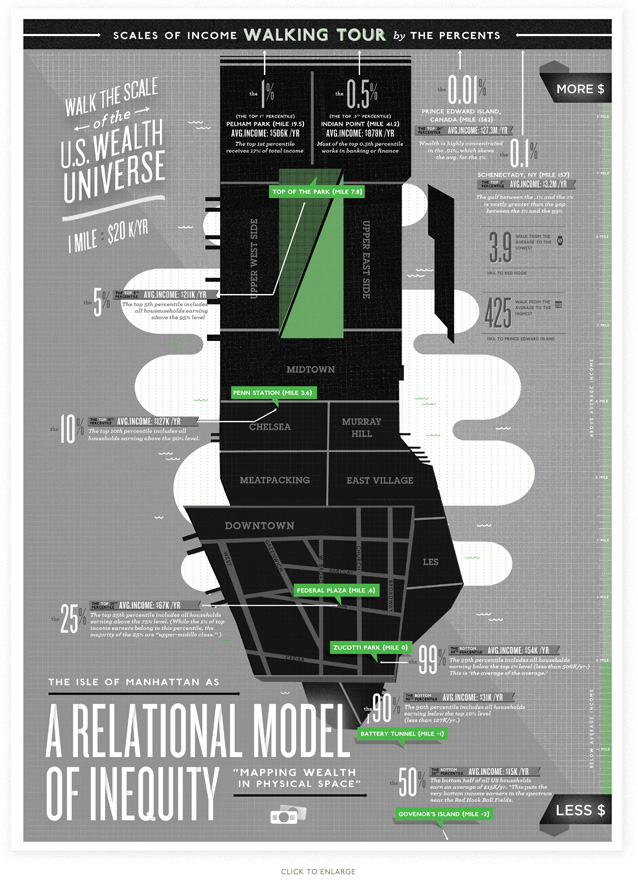
Kelli also does a lot of Infographics, including this Relational Model of Inequity which is a rather clever way to illustrate the inequity of wage differences in the US. In this map she mathematically works out the relativity of income brackets to a walking tour of New York city. In relative terms, to walk the distance of the top 0.01% of income earners, you would have to walk all the way through to the top of Canada or something ridiculous.


Image: Kelli Anderson


Since I've had lots of practise drawing maps for the Big Fag Press, I thought I could create a walking tour of Sydney looking at Sustainability figures.
Kelli has a lot of TED talks which are fairly inspirational also.

David Alan Harvey is a photographer and editor of Burn magazine, an online magazine which showcases the work of emerging photographers. I'm planning on submitting my work to Burn, and maybe next year applying for his Emerging Photographer Fund. David is currently working on a book collating his photography in Brazil, the layout of the book is extremely interesting - it is unbinded and allows for images to be moved around, and viewed juxtaposed next to each other in various ways. I loved his approach to portrait photograph - no fear, just the ability to be friendly, natural and get people to trust you.

Derek Henderson is also a portrait photographer, and has worked for many fashion magazines. What I loved about his work was the fact that he is an amazing professional photographer, and yet, like me, he doesn't do much studio lighting. He prefers ambient light, or if it has to be a studio, then just a single light to imitate daylight. He also minimises the retouching on his photographs and tries to portray true emotion. I was inspired by the lighting in these photographs:


*2 images: Derek Henderson

The Monkeys intrigued me because I'm really interested in the changing nature of advertising in the last few years, which I think has been driven by the rise of social media platforms. This is stuff like names on coke bottles - promotional material that is passed from screen to screen of users through generating individual interest in the product. This is kind of what The Monkeys do - it's kind of like guerilla advertising. They wanted to advertise Ice Break (the drink), and decided fulfill every guy's fantasy - attach a motor to random objects like a couch, break some world records and end up on the news around the country.


The Semi-Permanent publication was also interesting and I may have found some potential contributors such as:

Alyson Pearson (possible commissioned work: graphics over photography), James McLaughlin (possible digital photography manipulation help), and Daniel Caballero and Rebecca Murphy (both have artworks looking at the theme of fashion and death).

Sunday, April 15, 2012

Trampoline Day!

So today was Trampoline Day, which was actually a lot of fun.


 First Pat, Steve & Caroline introduced themselves and the day and how it would all run (notice people holding the fliers).


  The we "set the grid" by adding ourselves to the board and choosing what other topics to attend. Anyone could speak about anything - and the topics were as diverse as raw dog food diets to "how to learn MAD skills".


Here we have a passionate lady called Kylie who told us how she raised $33,000 on Pozible to get a whole lot of Australian wool processed in Australia, and talked about the impacts of wool processing in China on sustainability. I got a few hints about why my own pozible campaign wasn't successful! She really marketed her idea and "sold" it to everyone from politicians to knitter's guilds.


Similarly this is Tom, who also spoke about reasons why crowd-funding fails, I think he was from Kickstarter, or just knew a lot about it.


And another session I attended by Adam who spoke about 3D printing, which I'd never really heard of before - basically the idea that a printer can "print" an object out of plastic or metal, after being given a design to print. He seems to think this could be a huge revolution in the next decade - apparently it's possible that everyone will have a 3D printer at home, and any kind of object we need, we either design for ourselves, or download a "design" for. According to Adam, there is a kind of 3D printing "napster" type site, and that one day we will be able to "print" ourselves new livers, or indeed for a 3D printer, to print an iPhone, or just another 3D printer! No doubt this could change a lot of things about creativity and intellectual property.


A 3D printed duck:


 An intricate metal ball-thing:


And a mechanical contraption I'm still not sure what to call:


And of course we gave a presentation on the Big Fag Press, which got us a few interested parties wanting to work with us!

All in all, I've learnt a lot today.
*All photos are mine.

Thursday, April 12, 2012

Giopet's Graphic Art


And another caught my eye:


 *All images thus far from Giopet's Graphic Art Blog.

The latter no doubt inspired by Phil Poynter's "I didn't recognise you with your clothes on", Dazed & Confused 1998:

Ann-Sofie Back

So, part of my dissertation was looking at the way we use fashion to hide or conceal parts of our identities, and one of my case studies was the work of designer Ann-Sofie Back.


Here is an excerpt of my current dissertation draft:

 ___________________________

A case study relevant to this argument, is the work of Ann-Sofie Back, which blurs the line between art and fashion, looking at concepts of masking oneself with clothing, and as Beck states “drawing inspiration from mine and other women’s failures at achieving perfection and beauty” (in Granata 2007, p394).

There is a general consensus that Back is considered as an avant-garde designer, at least in the first few years of her work, because rather than focusing on fashion as a commodity, she broke certain practical fashion rules in order to expose ironies present in fashion systems, and the superficiality of fashion which she felt she grew up with (Granata 2007). Her interest in fashion was spurred by ideas like Goffman’s that “the individual... intentionally conveys misinformation[s]” (1959, p2). While many theorists have explored fashion as an indicator of identity, essentially clothing being the construction of a personal cultural expression (Wilson & de la Haye 1999, p1), Beck’s work expresses the notion of fashion as a disguise or mask, “rather than its alleged ‘authenticity’” (Granata 2007). Back’s work surrounds the idea that every aspect of fashion is “a perfect lie, watertight, nothing left to chance” an example of which is her “faux wasp-waist garments” which have a fake belt attached to the front which can be tightened to give a visual sense of thin-ness (in Granata 2007).

The concepts present in Back’s work are not news, in fact society has a general understanding and awareness of “the power [fashion] wields in defining and communicating our identity” (Arnold 1999, p490), and that clothing acts as a “superficial gloss” (Craik 1997 p1). Individuals use fashion deliberately to disguise and flatter aspects of their identity, one example of which we are all familiar with is the thought process we go through when selecting what to wear for a job interview (Goffman 1959, p47).  


 Arnold, Rebecca 1999, ‘The Brutalized Body’, Fashion Theory, Vol. 3 Iss. 4, pp. 487-502

Craik, Jennifer 1993, The Face of Fashion: Cultural Studies in Fashion, Routledge, London, New York

De la Haye, Amy & Wilson, Elizabeth 1999, “Introduction” in De la Haye, Amy and Wilson, Elizabeth ed., Defining Dress: Dress as Object, Meaning and Identity, Manchester University Press, Manchester

Goffman, Erving 1959, Representations of Self in Everyday Life, Anchor Books, USA

Granata, Francesca 2007, ‘Subverting Assumptions of Female Beauty: An Interview with Ann-Sofie Back’, Fashion Theory, Vol. 11, Iss. 4, pp. 391-402

____________________________

 I looked further into Ann-Sofie Back's work and I liked how her design work is driven by concepts in society she wishes to comment on or disagree with. Her concepts have included the way men look at porography, mental illness, and the idea of God. I think these concepts lead her to some very interesting places.


Porn:

 Porn 2:

   God:

God 2:

 *Images linked from Ann-Sofie Back

I suppose I'm looking at ways a fashion shoot could be made into something that can be interpreted as semi-satire, and I think anything as concept rich and opinionated as this could really work.

Wednesday, March 21, 2012

An Inspirational Story: Aimee Mullins

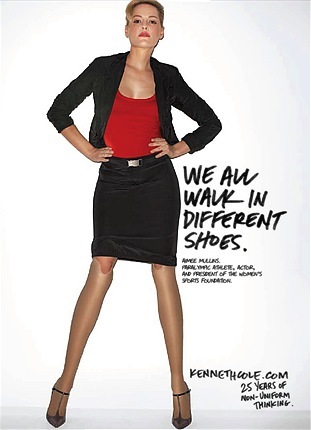
I recently heard a podcast from The Moth, which was a story told by Aimee Mullins so inspirational, it drew a few tears! Aimee needed both her legs amputated at the age of 1, and struggled through her adolescent life with accepting her disability. She managed to overcome her struggles by embracing the way she had to live, and finding the positives - which included world running records using prosthetic legs, having designer legs made for her by the late Alexander McQueen, and becoming a model to show off her "leg wardrobe".

Image by Terry Richardson

Photography: Nick Knight

Aimee Mullins in Cremaster 3, collaboration with artist Mathew Barney.

I.D. Magazine:  Howard Schatz Photography

Aimee Mullins as a muse for Alexander McQueen

She describes the turning point in her self image where her father told her, "you can see the knee joint when you walk, it's inappropriate, go back upstairs and change", and she refused. She refused "to hide something about [her]self that was true".

After that she started to embrace her disability, and speaks of her different legs, or "wearable sculpture" with humour. "I can be as tall as I want to be, I have different legs for different heights, I don't have to shave, I can wear open toed shoes in the winter and most importantly opt out of the kankles I would have most certainly inherited!"

"I had moved past acceptance, I was having fun with my difference - thank god I'm not normal, I get to be extraordinary! When we can celebrate and truly own what it is that makes us different, we're able to find the source of our greatest creative power."

Here is beauty in diversity.

Monday, February 20, 2012

Street Photography

I took Photography 1 as an elective a few summers ago even before the year I spent in France. I just took a look at one of my assignments from that subject and discovered that I've been interested in the ideas of individuality and "masks" for quite some time.


"In the many odd experiences I had in photographing strangers on the streets of Sydney, I realised
that each person, whoever they may be; has a mask or masks which they essentially show the
world. My desire to break down the masks was difficult. I soon realized that my best photos were
the ones where built up a small rapport with my subjects and got them to trust me enough to work
with me in showing what I wanted to portray. And whether or not they intended to, this meant
that in some way, they were posing for me even if they were pretending not to."


I was inspired very much by Weegee and Mary Ellen Mark, Henri Cartier-Bresson, and Robert Doisneau who seeked to, through their photographs and using varying photography philosophies, tell truths about events or people or things.

Here are some images that tell me some truths or stories:
*Images taken from respective photographers' published work or websites.


I must also mention the inspiration that came from my photography teacher Jon Lewis, inspiring not just through his own photography but through his enthusiasm, passion and humour, not to mention his activism in anti-whaling, promoting the detrimental effects of climate change, and of course being one of the founders of Greenpeace Australia. A big cheers and thanks to Jon Lewis.

My love of portraiture led me to taking photos of the homeless and buskers on the streets of Sydney. I would talk to these people, bring them cupcakes, give them some change, and tell them about my projects, and in return I got their stories, some hugs and smiles, and the chance to take their portraits.
*Photographs are mine.


I went to high tea at the QVB a few months ago. At the end of the occasion I took some left over little cakes and tarts with me in a box for a homeless man on Pitt st I'd seen while walking to the QVB that morning. The people I was with reacted in a way that admired this act, as if it would have been difficult for one of them to do it, even if they had wanted to. I guess maybe, I just don't see any boundaries. Nothing about handing a box of delicasies to a homeless man frightens me. But I guess people (even kind people) do feel a certain amount of apprehension. Which is maybe why I like talking to these people. Taking their pictures. I don't see a whole lot of difference between them and me, just possibly a series of unlucky circumstances. And I think everyone has a desire to "tell their story". To feel heard is one of few fundamental human needs along with food and shelter. I hope my photography helps tell their story.

As part of my pozible project, I'm hoping to be able to print some of these on the Big Fag Press.