About Me

My photo
Sydney, NSW, Australia
I'm an arts management worker/ artist/ designer. I work at Accessible Arts in administration and bookkeeping, but also work on various freelance activities from photography to graphic design. I'm Associate Partner at the ARI, the Big Fag Press, board member of Runway Australian Experimental Art and occasionally work at Bailey and Yang Consultants. My creative work has often been driven by social issues and commentary. This blog started as a way of documenting research for my honours year at uni, which I have continued, in order to gather inspiration for future artistic practice.
Showing posts with label Equality. Show all posts

Wednesday, August 13, 2014

Administration Officer at Accessible Arts

I've been AWOL from my blog as of late, and here's why:

In June I applied and received a position at Accessible Arts, an organisation who helps people with disability be fully included in arts and culture in NSW.

I've had contact with Accessible Arts in the past if you remember, John Demos' residency at the Big Fag Press, his solo exhibition at The Cross Art Projects including Josh Charles' beautiful doco, and the Supported Studio Network forum in which John and I were both panellists. I also attended a training day at Accessible Arts on Disability Awareness.

Anyway, I'm the Administration Officer and my role is largely database management, day to day bookkeeping with MYOB, and general administration. I am so grateful to be part of such a wonderful group of people, and it feels so rewarding to work towards a cause I believe is so important.

You can read the Accessible Arts July Newsletter in which I am introduced, and you can see me at the bottom of the staff information here

My colleague Jo Agius also welcomes me in her Auslan translation of the newsletter (at 5:24 - 5:40)


We've been learning a bit of Auslan (Australian Sign Language) at work, which I've found very interesting. I can say:

Hi, How are you? Welcome. My name is Louise. I'm 26. I live with my partner, Nathan, I like cats. I have one cat called Poppy. I am the administration person at Accessible Arts.

We've also learnt a host of other useful phases for use around work - things like, Are you busy? Can I help you? What time is the meeting? I forgot. I'm working on MYOB. This week, I'm learning the volunteer procedure. I am working on the database instructions. See you tomorrow. Have a good night/ weekend.

Our upcoming Arts Activated conference means we're also learning to give directions, like "turn left, go up the stairs/lift to the registration desk on level 2 in room 5."

As someone who speaks English, Polish and teaches French, I've found Auslan very interesting from a linguistic point of view. And some of my understanding of language sentence structures and tenses has actually been useful. I'm thinking about maybe taking an Auslan course, but I'm not sure if I have time.


Saturday, May 17, 2014

Other Worlds Zine Fair


The Big Fag Press has decided to withdraw our participation in the Sydney Writer’s Festival MCA Zine fair this year. We will instead redirect our energy by taking part in an alternative event - the Other Worlds Zine Fair.


Our decision comes after much deliberation. We are opposed to the Abbott government's Operation Sovereign Borders scheme which violates refugee and human rights. The recent expanded involvement by MCA sponsor Transfield in offshore detention centres in Nauru and Manus Island is something we at Big Fag Press take a stand against.

The Big Fag Press does not wish to endorse an event which is supported by money raised from the mandatory detention of refugees.

We are hopeful that awareness raised, no matter how small, will have an effect on the conscience and opinions of everyday Australians, which will in turn eventuate in changes to federal discriminatory laws.

Please come along to this event and say hey to us. The facebook event is here. I am personally making a zine for sale and we're taking along a lot of our latest prints!

Monday, March 10, 2014

Audio available - Accessible Arts Supported Studio Network Forum


The audio from Supported Studio Networks: Possibility and Potential has just been released. If you want to read a previous blog post about the project, see this previous post of mine.

Artist John Demos and I are panellists at the beginning of this one, Building Culture, but you can find the rest of the audios on the Accessible Arts site.

Saturday, September 7, 2013

Accessible Arts Disability Training Day


Yesterday courtesy of the Big Fag (thanks guys!), I attended a course on disability training at Accessible Arts run by Amanda Tink.

This was instigated by my project with John Demos, who's been doing a residency with our Press, funded by Arts NSW and administered by Accessible Arts.

There were quite a few things I learnt that I didn't know before. I generally treat everyone around me with respect, but when it comes a person with a disability, it's important to understand life from their perspective and make sure you know what phrases to use and how to approach them.

The section on stereotypes was one I was already very familiar with, but the section on communication was an important one for me. The difference, for example, between saying to a person who uses a wheelchair "do you need some help?" and "would you like some help?" is a good example because the idea of need perhaps takes away a little of their feelings of independence. That said, a person with a disability is not necessarily always in need of help - and they probably get asked that question about 10 times a day.

There's also many disabilities that are invisible. In fact, 1 in 5 Australians identify with having a disability, but the most prominent kinds of disabilities are psychological or health related. These people may find it difficult in work places as to whether or not to disclose their disability. Disclosure may mean they for example, would not prevail in a job interview. However should they not disclose, their disability may cause them difficulty at work.

Amanda played us this amazing video from the UK Disability Rights Commission: (you can find the second part on YouTube)


Language was also a key factor of the training session. Personally, I would never use words like spastic or retard, but I wasn't aware that perhaps a word like "handicapped" might cause offence. The best way to refer to people with impairments is to first regard them as a person, and to not assume anything about their life. So for example, you should say a "person with cerebral palsy" not "he suffers from cerebral palsy". You should not say "the deaf man", you should say "person who is deaf/ hearing impaired". And generally, it's better to find out a person's name! Also never talk about them as if they are not present, obviously. There's also things like being honest if you haven't understood what a person has said, and knowing the difference between simple language and moderate speed as opposed to talking to someone as if they were a child.

One thing that came up was how some people who are deaf sometimes don't consider themselves to have an impairment at all. Rather, that their ability to use sign language simply places them in a separate linguistic culture, one which has been extensively developed. I didn't know that before.

50 years ago being left handed was considered something of a disability. 20 years ago being gay meant you had a psychiatric condition. It's the society and world that shifts. It was interesting to look at how society has treated the issue of disability over time, beginning with a religious perspective that a person with an impairment must be so because he had sinned, or his family had sinned. Then from a medical perspective we would do the best for a person we could medically, and then they would just have to do the best they could to try and integrate within their family and get by.

The current model stemmed from the UK in the 70's where we think of people who have an impairment as not them being disabled, but rather than society itself is disabling them because of all the barriers they face, taking a wheelchair up stairs, or trying to find a cinema session that has audio captions.

Not many organisations have Disability Action Plans - only about 40% of arts organisations in Australia. It's important to understand that it's not a matter of building a ramp and hanging some audio tour headphones on the walls, it's about creating an environment that is entirely welcoming and not hostile through a range of means, both physical and emotional, and then, making the community of people with disabilities aware of those changes.

Anyway, I learnt a lot at the training session and I'm sure it will help me in my many current endeavours!

Wednesday, August 14, 2013

John Demos' Accessible Arts Residency at the Big Fag


John Demos. Photo Louise Anderson

John Demos working at the Big Fag Press, Photo Louise Anderson

John Demos with his original work "Antitoxicus" Photo Louise Anderson

For about 3 months we've had John Demos down at Firstdraft Depot working on some prints on the Big Fag as part of his residency mentorship program thanks to his Amplify Your Art grant. John has been coming in one day a week to create his beautiful works and experience the process of making those works into prints on our offset proofing press.

I've been mostly managing this project solo, and it's been an amazing experience for me. Art is the way John experiences his life, and his works are an exploration of belonging and home, and the words and images that mean those things to him. When he's not practising, John is browsing countless Sydney galleries where the attendants all know him by name. This is a kind of passion I feel is rare in just about any field.

Whilst down at the Press, I introduced John and his liaison Kristina Tito to Jo Holder from The Cross Art Projects gallery. He's been offered the opportunity to exhibit his work at the end of our mentorship there in October/ November. This is such a great opportunity for him to make contacts, show his work and most importantly give a voice to artists like himself who benefit so much from Supported Studio Networks.

We're just in the printing phase now, and the entire project is taking shape. I organised some paper sponsorship from K.W. Doggett, which has been great for John to experiment on. He loves discovering new kinds of paper and mediums to work with, and asks endless questions about ink mixing, how the press works and what kind of things we've printed on before.

We've made up ten metal plates of John's work separated into different colours, and he'll end up with a series of about 4 works, plus a few others where he will experiment with layering different works on top of each other, and then using them as a basis for more hand- rendered work.

Josh Charles has been making a short documentary of the entire project.

Spending any time at all with John has shown me that he has a little story about everything. It's really important to give John a platform from which to tell those stories - through his art, but also his practice, which can potentially, as he says, "influence other people towards art".

Tuesday, July 16, 2013

Cake Decorations in Love

http://images.theage.com.au/2013/07/15/4572207/art-SHE-lesbian-20130715162720469250-620x349.jpg
Image from: The Age, 'Gay or Straight, Love is Love'


Those of you who know me, know I'm a 'wannabe' cake decorator, so this image caught my eye because the decorations are really awesome and something I'd love to try. However currently, this image - as cute as it is - is controversial.

I was once approached on the street by a charity worker who asked me what I thought is the most fundamental human right. I think he wanted me to say clean water, because polluted water is one of the most serious issues faced globally. Anyway, I wasn't really thinking, but my response was "love". I think maybe I threw him for a second, but yes, I truly believe that along with clean water, food and shelter, people have the right to love and be loved, and to be heard and understood.

So hear me out.

I'm an atheist, I don't believe in any higher governing power, but that doesn't mean I don't have a set of morals and values by which I live. I do, and one of them is the fact that in this sometimes scary world, humans have the ability to love one another, to do good to one another, and to fulfil each others' lives. I would say this belief is something close to what I might call my faith. It is what makes me a thankful person. It is what brings meaning to my life.

So the idea that people oppose the relationship and marriage of two people who love each other, and intend no harm to society, that is a threat to my beliefs.

Because in my philosophy of right and wrong, every person in this world deserves the chance to be happy.

For me, that's all there is to it.

Monday, May 20, 2013

Check out my guest blog posts on 3things.org.au!

A couple of posts from this blog have been reposted by 3things.org.au

You can check them out here - Silk - what you don't know probably won't upset you and H'mong Bracelets and Fair Trade.

Just changing the world 3 things at a time. Actually, while I've got you here, please do me a favour and go to this site: http://www.thehungersite.com Click a button on all the pages to donate to charity - it's free. For me? Please? (it takes like... 30 seconds)

*Image from 3things.org.au

Saturday, June 2, 2012

SurveyMonkey thoughts

I've been reading through my 44 SurveyMonkey responses. Some of the answers have been really thought-provoking. About 80% of people who answered my survey described themselves in general as "informed consumers", which is great - that's pretty much the target market I was looking for. In retrospect I would have not titled the survey as "fashion", because I think a few people answered "no" as they are not informed consumers of fashion.

Consumers feel strongly about topics across a wide spectrum of issues - political, environmental, religious, culture, technological and social. Some specific issues brought up were: gender equality, gay rights, fair trade, design authenticity, poverty, health, secularism of ethics, "slow" design, renewable resources, sustainable town planning & city building, the banning of smoking in public, support of local & organic produce, anti-animal testing, anti- mass productions, and waste/ landfill ethics. The most prominent issue for my survey responders was environmental sustainability and fair trade. 7% of my responders did not answer the question.

70% of my responders avoid shopping at specific stores or buying specific products because of moral/ ethical issues. Stores include: Max Brenner, Fast Fashion Chains, McDonalds, BP, Woolworths/ Coles, Nike, Starbucks, Gloria Jeans, Cotton On, Nestle, Proctor & Gamble, Zara, Bayer Pharmaceuticals, Shell, City Beach, Mossimo, YD, Amazon and Portmans. Products include: Non-organic skin/ beauty products, products made in China, non-organic foods, non-Australian made products, products which use palm oil, cheap fashion, fur products, products tested on animals, caged eggs, large coffee chains, "adult" products.

Responders said they shop at a huge variety of stores. There were responses rangeing from discount stores like hot dollar, zara, topshop, kmart & supre, chain stores like sportsgirl, portmans, jay jays, witchery and general pants, designerwear like gorman, sass& bide, allanah hill, miu miu, mimco, and some higher fashion stores like chanel, prada and bally. There was also a number of people who said they shopped at local boutiques, and well as online stores like etsy.

Magazines of responders included Frankie, Cleo, Russh, W, Numero, Oyster, Harper's Bazaar, Vogue, Lula, Dazed & Confused, OK, Grazia, Shop Til You Drop, Wallpaper, ID and Madison. Other publications: SMH, Daily Telegraph, BBC online, ABC online, the Australian, Monocle, the Guardian, New York Times online, New Scientist, Reddit, MX, and Sunday magazine. Blogs include: TheyAllHateUS, amandpalmer, showstudio, and design milk blog.

I then tried to gain an understanding of my consumers by looking at the way they make decisions. I separated answers into 4 categories: "humanist", "indecisive", "safe" and "personal". So, for example buying a present for a friend, giftcard would be the "indecisive" option, jewellery would be the "safe" option, something at the oxfam store would be "humanist" and taking her out to lunch would be "personal". In retrospect, I'm not sure these answers worked the way I wanted them to. The response for my movie choice one, for example "A Comedy because there's an actor in it who was funny in some other movie so you think it'll probably be okay" was my "safe" option, but I'm not sure it really determined attitudes, people may have simply chosen it because they like comedies.


I think the most interesting answers came from my question about definitions of beauty and weather society's ideals match what people's ideals are. Every single person who answered the question (34 responses) said they largely disagreed with societal/ media repsresentations of beauty, or that they were influenced by them and wish they weren't. There were many responses who said they recognised beauty in confidence and personality: "inner beauty", and beauty in people who were unique and different. It is therefore so surprising that media strays so far from consumer demands. It is possible, also, that some people shaped their responses based on social desirability, ie what they "should" say in reponse to such a question. But I think that largely the reponses were truthful.


45% of reponders said they did consider or strongly consider a product to have more monetary value if it is ethical/ sustainable/ fair trade/ funding charities/ protesting against malpractice/ etc. 56% said it did sometimes, and only 7% said it didn't. Examples of products people pay more for are: local food produce, fair trade coffee, free range eggs, oxfam toys, underwear made in Australia, organic products, hand made clothing, lush cosmetics, Trilogy products, organic materials & cotton, authenticity of design, vintage clothes, charity products, and non-mass produced products.
Tuesday, April 3, 2012

A Small Victory

*Image referenced from facebook: Gay Rights in Australia


For the Senate Enquiry ending today, 45,000 Australians pledged their support for marriage equality, one of whom was me. This is a significant milestone and unprecedented support for a Bill which will legalise same-sex marriage, which I am crossing my fingers will go through.

Wednesday, March 21, 2012

An Inspirational Story: Aimee Mullins

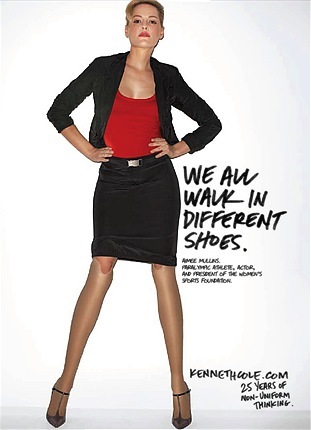
I recently heard a podcast from The Moth, which was a story told by Aimee Mullins so inspirational, it drew a few tears! Aimee needed both her legs amputated at the age of 1, and struggled through her adolescent life with accepting her disability. She managed to overcome her struggles by embracing the way she had to live, and finding the positives - which included world running records using prosthetic legs, having designer legs made for her by the late Alexander McQueen, and becoming a model to show off her "leg wardrobe".

Image by Terry Richardson

Photography: Nick Knight

Aimee Mullins in Cremaster 3, collaboration with artist Mathew Barney.

I.D. Magazine:  Howard Schatz Photography

Aimee Mullins as a muse for Alexander McQueen

She describes the turning point in her self image where her father told her, "you can see the knee joint when you walk, it's inappropriate, go back upstairs and change", and she refused. She refused "to hide something about [her]self that was true".

After that she started to embrace her disability, and speaks of her different legs, or "wearable sculpture" with humour. "I can be as tall as I want to be, I have different legs for different heights, I don't have to shave, I can wear open toed shoes in the winter and most importantly opt out of the kankles I would have most certainly inherited!"

"I had moved past acceptance, I was having fun with my difference - thank god I'm not normal, I get to be extraordinary! When we can celebrate and truly own what it is that makes us different, we're able to find the source of our greatest creative power."

Here is beauty in diversity.

Sunday, March 18, 2012

Diversity - A Big Question?

Since the "size zero" issue came to the forefront after the deaths of several very underweight models, there have been several initiatives to create modelling diversity, some of which retaliatied by using plus sized models on the catwalks.
As one retaliation, Gaultier in 2006 used this model (below), which definitely made a statement, I'll agree, but I'm just not sure it didn't go too far. Just like the abundance on size zero models, this model is not a role model for a healthy body image either.
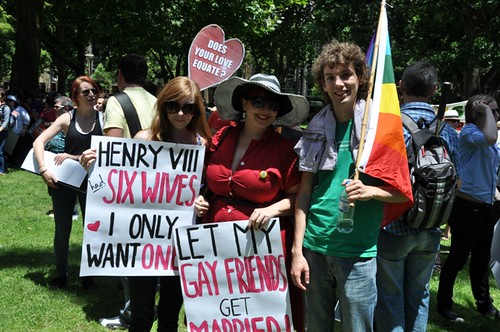
 *Image from trendhunterstatic.com

Mark Fast, a London based fashion designer who uses a lot of body-hugging knitwear as his signature used what he terms plus size models alongside thinner models for several shows in 2010-2011. He states, "I think that women have such beautiful attributes, and there is so much beauty there, there shouldn’t be so much pressure to rearrange your body to a certain body type to feel happy. I have been realizing over the last few years that beauty is… is something that should be taken care of. There is so much pressure to be thinner, but if you are happy with who you are, and you are healthy and taking care of yourself, that is when you realize 'I am ok like this.' Just enjoy your body and your life".

 *2 images from dailymail.co.uk

 His collections were met with both praise and criticism, some of which I can see as comments to this article. I cannot believe that some people have been calling these women "fat". They are a szie 12- 14, which personally, I'm not even sure why we're calling this plus sized - the average Australian woman is a size 12-14. Obviously these women are a little larger than what you'd expect for healthy fashion models, but it just goes to show how skewed the respresentations of beauty are, if people think this is overweight. It is not. Someone commented on that article to say that they think most women of a healthy weight would be a size 10. Did anybody stop to consider that a medically "healthy" weight for someone of average height has a span of about 15 - 20 kilos? That roughly translates to about 4- 6 dress sizes. That means someone a healthy size 8 could also be a healthy size 12 -14.

*2 images from dailymail.co.uk

I mean, next to these women, who doesn't look fat?

Another example is Myer's 2011 Big Is Beautiful Plus Size Show, which also seems to have received both praise and criticism. The praise was mostly along the lines of "well done for trying", I think the general concensus was that the fashion created for the plus sized girls was too "frumpy" and what you'd expect from "plus size" fashion - ie. not so fashionable.

*1 image from Myer's Big Is Beautiful Show

The rest of the criticism was about the women involved - that they were fat, unhealthy, bad role models and altogether unspectacular, even disregarding their weight. The absolute crude-ness of some of the comments really bothered me, especially when it came from some clearly uneducated voices.

One argument was that models should be thin and pretty because that is their job and that is what they have to be good at. "Frankly, why should we? Standard-size models, like Olympic athletes, are a genetically gifted species. Most consumers understand they will never look like them. The simple fact is that clothes look better on beautiful, slender young women."

My response to that is two things. One, no, many consumers do not understand that models present us with a fantasy world, and even if they do, that does not stop them from desiring to embody the images they are shown their whole lives, whatever the cost - that is the goal of advertising. Secondly, with Olympic athletes, we are constantly hearing interviews and seeing the effort that they put in through training and eating right and everything else, that it is completely transparent that they spend a lot of effort and money to achieve what they can do. We don't see behind the scenes of the life of models - they don't tell you how much they really eat, how much time they spend exercising, how much money they spend on personal trainers. And thus, we get the impression that this could be possible for us, when it is not. I just heard on the radio yesterday that Jennifer Aniston spends $8,000 a month on how she looks! This is a reality only available to those whose professional life is looking good.

In my opinion, these shows have gone about it slightly the wrong way. The problem with putting "plus size" models on a pedestal is that they are going to be criticised. We should be aiming for a general sense of diversity that is not going to come about because someone got a couple of curvy girls on a catwalk.

There is now the abundance of people looking at the effects of fashion imagery and models on a collective sense of body self esteem such as Angel Sinclair, the founder of Models of Diversity and Sinclair Model Management.

* 2 images from modelsofdiversity.org

And of course I can't forget Caryn Franklin who I have already spoken about in this blog, and her company AllWalks. All walks did a project called Snapped, which incorporated several designers including Stella McCartney to portray some of their looks on models which showed diversity - in size, age, and skin colour. And to me, it achieves exactly that - diversity.


*5 images from allwalks.org

On a slightly unrelated point, Estee Lauder did an advertising campaign to include some diversity too.

*1 Image from Estee Lauder Idealist campaign.

I'm not entirely sure of the success of this one. Diversity to me doesn't mean pulling one girl from each demographic of society and placing them together. It's by looking at people as individuals, disregarding race, skin colour, age, size, disability, etc, and finding the beauty in who they are.

Monday, March 12, 2012

Self Esteem - Narcissistic?

I read this article on the push for body image equality last week.

The way I read it, the author seemed to be saying that total body image equality as being pushed by the feminist society, is equal to narcissism. This concept outraged me - firstly self esteem is not necessarily just a feminist ideal - it's a human right. Self esteem is a huge part of a person's mental well being, and every single person has that right.

Obviously a person who is well outside the range of "health" is not going be conventionally beautiful. But beauty is, or at least, theoretically SHOULD BE a subjective term. Healthy is an objective term - it can be brought down to numbers and medical researched opinions, but beauty is not objective. The author seems to be saying that telling someone who is very overweight they're beautiful is wrong because they should be trying to change the fact that they're overweight. Okay, but generally people need to have self esteem in order to better themselves. Someone who is already overweight in all likelihood has self esteem issues already stopping them from helping themselves. Generally, someone who feels beautiful on the inside, as a whole, is going to be able to try harder to make themselves healthy (and thereby conventionally beautiful) on the outside.

Also, the above only relates to weight in terms of unhealthiness. A person with certain illnesses or disabilities with which they were born, which put them outside the ideal of conventional beauty, technically cannot seek to better themselves. Should we really be excluding them from the ability to feel beautiful? I really think not - in fact that probably borders on discrimination.

Lastly, we're assuming that beauty is merely a physical attribute, when it is certainly not.

I think my point is that there are things people think, things that pass through everyone's head, that should never be said outloud. Okay, so we're constantly fed images of what it beauutiful and what is not, and you pass someone in the street who plainly does not fit those characteristics. It's fine to think that, it's not fine to say it. And I think this author is pushing that boundary.

Friday, March 2, 2012

"I Do" Support Marriage Equality


Today was I DO day! Lots of inspirational photos from Australians who support marriage equality.


[All images sourced from the I Do Day facebook page]


“One day the marriage equality fight will look as archaic as George Wallace standing on the University of Alabama steps keeping James Hood from attending college because he was black,” he reasons. “People will be embarrassed to have been on the wrong side.”

“Every time we’ve stood against equality, we’ve been on the wrong side of history… It’s the same kind of argument they made when they didn’t want blacks to serve in the military, or when they didn’t want blacks to marry whites.”

Tuesday, January 31, 2012

Rally for Marriage Equality

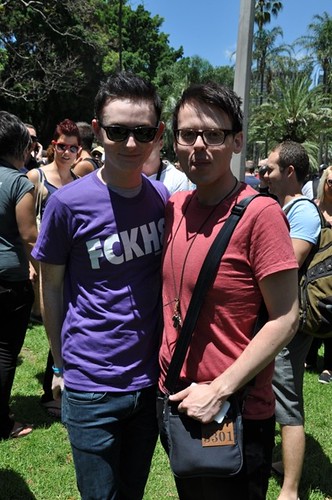
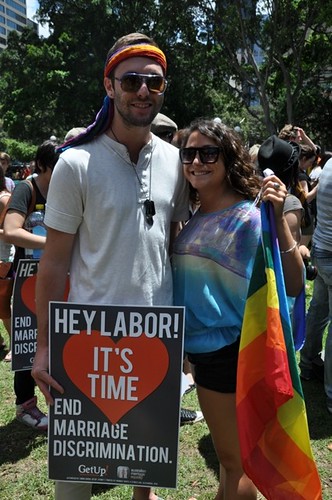
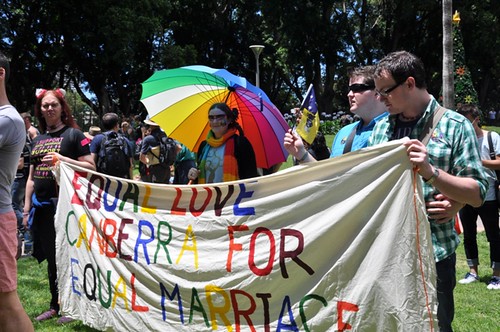
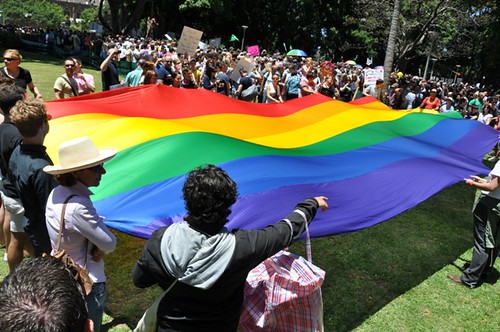
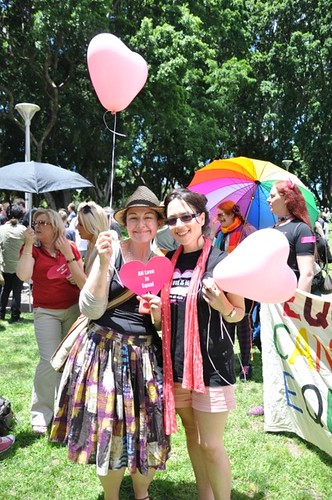
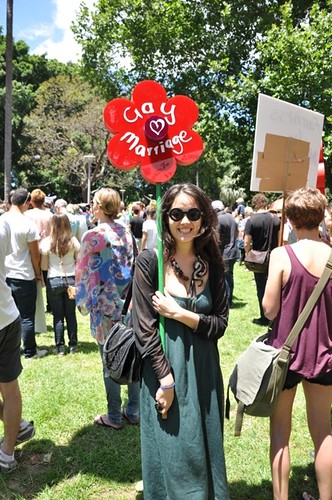
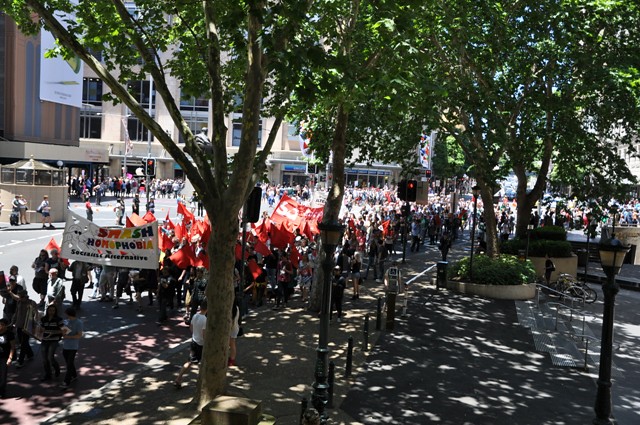
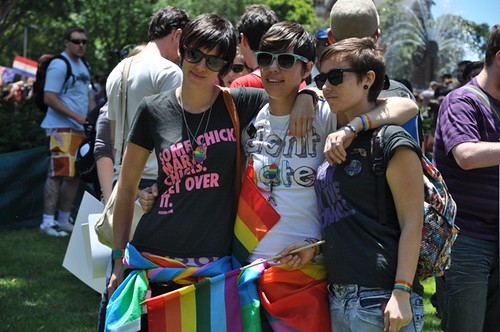
Last year on December the 3rd I went to Sydney's Rally for Marriage Equality as an opportunity to do some research, take some photos and generally support a cause I believe in. My opinion is pretty much that there should be more love in the world, so who cares what form it takes. I understand that "marriage" is technically a religious term, so honestly, if the Church doesn't want to get involved in gay marriage, that's their choice. But I believe in the separation of Church and State, and the idea that two people in love don't have equal rights just because of their sexuality pretty much just seems like discrimination. Why stand in the way of people's happiness? And considering the rate of suicide among the gay community, I really think governmental support could go a long way in sending a strong message.

Here's some of my photos from the day:
I loved how everyone took the opportunity to dress for thr cause, come out and be part of this very colourful community. Confidence in numbers I suppose!


The rest of this Flickr set can be found here. Some of my photos were also used in this beautiful Coming Out Journal on Tumblr.