About Me

My photo
Sydney, NSW, Australia
I'm an arts management worker/ artist/ designer. I work at Accessible Arts in administration and bookkeeping, but also work on various freelance activities from photography to graphic design. I'm Associate Partner at the ARI, the Big Fag Press, board member of Runway Australian Experimental Art and occasionally work at Bailey and Yang Consultants. My creative work has often been driven by social issues and commentary. This blog started as a way of documenting research for my honours year at uni, which I have continued, in order to gather inspiration for future artistic practice.
Showing posts with label Mentors. Show all posts

Wednesday, August 14, 2013

John Demos' Accessible Arts Residency at the Big Fag


John Demos. Photo Louise Anderson

John Demos working at the Big Fag Press, Photo Louise Anderson

John Demos with his original work "Antitoxicus" Photo Louise Anderson

For about 3 months we've had John Demos down at Firstdraft Depot working on some prints on the Big Fag as part of his residency mentorship program thanks to his Amplify Your Art grant. John has been coming in one day a week to create his beautiful works and experience the process of making those works into prints on our offset proofing press.

I've been mostly managing this project solo, and it's been an amazing experience for me. Art is the way John experiences his life, and his works are an exploration of belonging and home, and the words and images that mean those things to him. When he's not practising, John is browsing countless Sydney galleries where the attendants all know him by name. This is a kind of passion I feel is rare in just about any field.

Whilst down at the Press, I introduced John and his liaison Kristina Tito to Jo Holder from The Cross Art Projects gallery. He's been offered the opportunity to exhibit his work at the end of our mentorship there in October/ November. This is such a great opportunity for him to make contacts, show his work and most importantly give a voice to artists like himself who benefit so much from Supported Studio Networks.

We're just in the printing phase now, and the entire project is taking shape. I organised some paper sponsorship from K.W. Doggett, which has been great for John to experiment on. He loves discovering new kinds of paper and mediums to work with, and asks endless questions about ink mixing, how the press works and what kind of things we've printed on before.

We've made up ten metal plates of John's work separated into different colours, and he'll end up with a series of about 4 works, plus a few others where he will experiment with layering different works on top of each other, and then using them as a basis for more hand- rendered work.

Josh Charles has been making a short documentary of the entire project.

Spending any time at all with John has shown me that he has a little story about everything. It's really important to give John a platform from which to tell those stories - through his art, but also his practice, which can potentially, as he says, "influence other people towards art".

Monday, July 30, 2012

Mamamia

I was recently directed to this article by Amanda Dallimore on living with Anorexia via The Butterfly Foundation on facebook. It's great being connected to all these people doing fabulous things and telling true stories about body image - such a contrast to anything you'd find in any magazine.

I looked at doing an internship placement with mamamia.com.au earlier in the year when I was researching Mia Freedman as one of my inspirations. I actually just read an interview with her in the latest Dumbo Feather. I think the work she's done is amazing, and I may apply for that internship next year when I have more time.

Monday, April 2, 2012

Paul Kuczynski

I came across some satire that I found very interesting by an artist called Paul Kuczynski. It's helpful to be able to read Polish to navigate the website, but most of the art speaks a language of its own.


Although the work has received some criticism about being too literal for art, or too comercialised, I actually think as far as satire goes, some of the issues brought forward are shown in clever, witty ways that bring the point across well.

I don't think it's easy to come up with visual ways to bring across your social commentary - and some of these images do this in very imaginative ways.

*All images from Paul Kuczynski.

Wednesday, March 28, 2012

Mentors Re-cap

Through my blog so far I have identified several potential mentors like Caryn Franklin, the founder of All Walks Beyond the Catwalk, Angel Sinclair, the founder of Models of Diversity and Sinclair Model Management, all who try to promote an ideal of beauty in diversity. I have also looked at Neil Kerber, the cartoonist who created Polly Bean, and Mark Fast the fashion designer who collborated with All Walks, and also used "plus size" models in his catwalks for several seasons. Recently I've been looking at some writers and editors of magazines. Lara Mcpherson is a fashion journalist particularly interested in issues of sustainabililty, Tullia Jack, a writer and researcher into sustainable fashion, and Mia Freedman, a former editor of several magazine, writer and advocate in women's body image, an example of her writing is here.

For my 4 mentors I have chosen Caryn Franklin, Angel Sinclair, Neil Kerber and Mia Freedman, of which I will use Caryn and Mia as my case studies.

Sunday, March 18, 2012

Diversity - A Big Question?

Since the "size zero" issue came to the forefront after the deaths of several very underweight models, there have been several initiatives to create modelling diversity, some of which retaliatied by using plus sized models on the catwalks.

As one retaliation, Gaultier in 2006 used this model (below), which definitely made a statement, I'll agree, but I'm just not sure it didn't go too far. Just like the abundance on size zero models, this model is not a role model for a healthy body image either.

 *Image from trendhunterstatic.com

Mark Fast, a London based fashion designer who uses a lot of body-hugging knitwear as his signature used what he terms plus size models alongside thinner models for several shows in 2010-2011. He states, "I think that women have such beautiful attributes, and there is so much beauty there, there shouldn’t be so much pressure to rearrange your body to a certain body type to feel happy. I have been realizing over the last few years that beauty is… is something that should be taken care of. There is so much pressure to be thinner, but if you are happy with who you are, and you are healthy and taking care of yourself, that is when you realize 'I am ok like this.' Just enjoy your body and your life".

 *2 images from dailymail.co.uk

 His collections were met with both praise and criticism, some of which I can see as comments to this article. I cannot believe that some people have been calling these women "fat". They are a szie 12- 14, which personally, I'm not even sure why we're calling this plus sized - the average Australian woman is a size 12-14. Obviously these women are a little larger than what you'd expect for healthy fashion models, but it just goes to show how skewed the respresentations of beauty are, if people think this is overweight. It is not. Someone commented on that article to say that they think most women of a healthy weight would be a size 10. Did anybody stop to consider that a medically "healthy" weight for someone of average height has a span of about 15 - 20 kilos? That roughly translates to about 4- 6 dress sizes. That means someone a healthy size 8 could also be a healthy size 12 -14.

*2 images from dailymail.co.uk

I mean, next to these women, who doesn't look fat?

Another example is Myer's 2011 Big Is Beautiful Plus Size Show, which also seems to have received both praise and criticism. The praise was mostly along the lines of "well done for trying", I think the general concensus was that the fashion created for the plus sized girls was too "frumpy" and what you'd expect from "plus size" fashion - ie. not so fashionable.

*1 image from Myer's Big Is Beautiful Show

The rest of the criticism was about the women involved - that they were fat, unhealthy, bad role models and altogether unspectacular, even disregarding their weight. The absolute crude-ness of some of the comments really bothered me, especially when it came from some clearly uneducated voices.

One argument was that models should be thin and pretty because that is their job and that is what they have to be good at. "Frankly, why should we? Standard-size models, like Olympic athletes, are a genetically gifted species. Most consumers understand they will never look like them. The simple fact is that clothes look better on beautiful, slender young women."

My response to that is two things. One, no, many consumers do not understand that models present us with a fantasy world, and even if they do, that does not stop them from desiring to embody the images they are shown their whole lives, whatever the cost - that is the goal of advertising. Secondly, with Olympic athletes, we are constantly hearing interviews and seeing the effort that they put in through training and eating right and everything else, that it is completely transparent that they spend a lot of effort and money to achieve what they can do. We don't see behind the scenes of the life of models - they don't tell you how much they really eat, how much time they spend exercising, how much money they spend on personal trainers. And thus, we get the impression that this could be possible for us, when it is not. I just heard on the radio yesterday that Jennifer Aniston spends $8,000 a month on how she looks! This is a reality only available to those whose professional life is looking good.

In my opinion, these shows have gone about it slightly the wrong way. The problem with putting "plus size" models on a pedestal is that they are going to be criticised. We should be aiming for a general sense of diversity that is not going to come about because someone got a couple of curvy girls on a catwalk.

There is now the abundance of people looking at the effects of fashion imagery and models on a collective sense of body self esteem such as Angel Sinclair, the founder of Models of Diversity and Sinclair Model Management.

* 2 images from modelsofdiversity.org

And of course I can't forget Caryn Franklin who I have already spoken about in this blog, and her company AllWalks. All walks did a project called Snapped, which incorporated several designers including Stella McCartney to portray some of their looks on models which showed diversity - in size, age, and skin colour. And to me, it achieves exactly that - diversity.


*5 images from allwalks.org

On a slightly unrelated point, Estee Lauder did an advertising campaign to include some diversity too.

*1 Image from Estee Lauder Idealist campaign.

I'm not entirely sure of the success of this one. Diversity to me doesn't mean pulling one girl from each demographic of society and placing them together. It's by looking at people as individuals, disregarding race, skin colour, age, size, disability, etc, and finding the beauty in who they are.

Wednesday, March 14, 2012

Cartoon Supermodel: Polly Bean


Meet Polly Bean, the first Cartoon Supermodel by Neil Kerber.

*Images sourced from above link, credited to Neil Kerber.

Monday, February 27, 2012

Bodies Talk

[Image sourced from AllWalks]

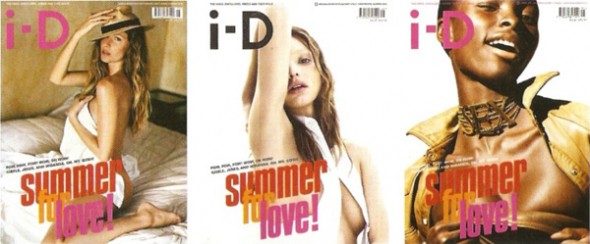
 I recently read an article called Bodies Talk by Caryn Franklin, the founder of All Walks Beyond The Catwalk which I'd grabbed from i-D magazine 2010, The head, the shoulders, knees and toes issue, pages 130- 131.

All Walks is a fascinating initiative, that I will dig deeper into for a separate blog post, but I just wanted to share some of what I perceived as 'truths' that spoke to me from this particular piece of writing.

This article, written during London Fashion Week 2012, targets how the fashion industry is an indicator of social change and dialogue with innovative designs and forward thinking, yet has such a retrograde representation of the human body.

Interestingly the ideals of modern society have this attraction to what is essentially an unhealthy weight for a woman, directly opposes subconcious biological genetic processes in the male brain for the purposes of evolution to choose a healthy female partner.

The article critiques the industry as "The Authority On The Way Clothes Look Best" for knowingly having a huge psychological impact on women, yet doing little to influence positive body image ideals and self esteem.

According to the article, whether the consumer is an intelligent self actualised woman or pre-teen (i.e intelligence, age, etc) has little relevance on the ability to think logically. When presented with fashion advertisments, the visuals impact the psyche on a subconscious level and the consumer cannot make a separation between the clothes and the body. This brings up a concept I have already spoken about in this blog about the goal of advertising in general being to make the consumer desire the product by feeling their own lifestyle to be inferior or as Caryn puts it "rectifying a Hopelessly Imperfect Existence with unnecessary purchases". There is little ability for us to think critically of images 'Gee, I wish I looked like her, maybe I should get that dress - hang on, even she doesn't look like that!', because "institutionalised body dysmorphia is a default setting for all of us".

Another issue I've spoken about before - airbrushing, is touched on in this article too. It basically says that the result of the manipulation of images means what is achieved is all the tiny things that make one body unique to another one are gone, and therefore we have "a repetition of the same unachieveable thing over and over and while we become more disoriented and miserable, the large corporate benefits." What happaed to beauty in the individual, the difference, the 'otherness'?

And this is not limited to the size of models. The scarcity of varying ethnic models on catwalk and fashion visuals could explain why Caucasion women suffer lower levels of self esteem than darker skinned women - as a white woman we're constantly being presented with images of what we "should" look like.

The article asks of fashion, "what if the entire industry lead the way in acknowedging what a powerful force it in in communicating to woman about their bodies, more powerful than music, sport, art and film put together, and Actually Did Something About It?" Obviously because of profit loss, established companies cannot afford to change their images now without risking a loss, so, as the article points out, it has to start within Fashion Educational Institutions, so that the next generation of designers/ creative directors/ stylists/ photographers/ etc are hell bent on promoting a revolutionary change in the industry and in the world of body image mental health.

Not to criticise my design degree, because I understand that we have a limited amount of resources within this degree. But the Womenswear fashion major students were told to aim to a size 9 model, because size 8 is a little on the underweight side and that's not what UTS wants to promote, and the models in the Graduate Show will be turned away if they are underweight. Well, firstly, I was at last year's fashion graduate show, and I did think there were a fair few unhealthy models included in the catwalk. Plus, we're constantly being told "Don't design for yourself, design for the market that's out there". I think the average Australian Woman is a size 12-14, so there is a certain irony to catering to the market by only creating clothes that look good on people who already look good. Using a size 9-10 model probably keeps you in the realm of a fairly healthy body, but we're still going for the thinnest possible ideal in the healthy range, which is not really a representation of the real world.

The industry may think that advertising their clothing on the most beautiful models they can find, is promoting their clothes in the best light. Well, studies show people would be more likely to buy clothes if they see them on a person who vaguely resembles them - age, size, ethnicity. Only, if they tried say, using a model for a photoshoot who's a size 14, they might discover that after grading to the size and essentially trying to fit that design to a larger person, well it distorts the original intention of the garment. So maybe we should have designers who start draping on size 12 or 14 mannequins - why should someone within the range of a healthy weight have to go to "plus size" stores to find clothing specifically designed for their body shape?

I liked this article. And I find myself constantly being highly critical of everything the fashion industry stands for. Well, also in our lecture this morning we were told industry members were excited about designers with ideas that could change their industry. Maybe I'm not as lost as I think I am.


 [Image sourced from AllWalks]